There is no such thing as “scaled up”

How manufacturing challenges change as biotechnology moves from research to commercial supply.
November 1, 2026


“Scale-up” sounds like a problem of size. A process works in the laboratory; the next task is to make more of it: larger equipment, larger batches, higher production volumes. In biotechnology, that picture is often misleading. A research process may not yet be sufficiently defined for clinical manufacturing. A process operating under GMP (Good Manufacturing Practice) may need to be transferred to another facility. A setup adequate for an early trial may be unsuitable for Phase III.
Scientific success does not eliminate uncertainty. It changes which uncertainty matters next.
Even regulatory approval does not guarantee that commercial demand can be supplied reliably. There is no single transition from laboratory to industry. The meaning of “ready” changes as a biotechnology program develops. Scientific success does not eliminate uncertainty. It changes which uncertainty matters next.
A warning from Provenge
Dendreon’s Provenge (sipuleucel-T), approved by the US FDA in 2010 for advanced prostate cancer, was a personalized cellular immunotherapy. Each patient’s cells had to pass through a dedicated manufacturing and logistics system rather than a conventional large-batch production line.
Dendreon expanded its manufacturing network, operating FDA-approved facilities in New Jersey, California, and Georgia. Yet uptake was slower than expected. By the second quarter of 2012, the cost of goods sold had reached 77% of net product revenue. In July 2012, Dendreon announced plans to close its New Jersey plant and consolidate production at the remaining facilities. [1]
Technically available capacity and economically productive capacity are two different things.
The lesson is not that Provenge could not be manufactured. It could, and patients received it. Rather, technically available capacity and economically productive capacity are two different things. Regulatory approval and commercial manufacturing had answered important questions, but not whether the network would be sustainable at the level of demand actually realized.
Sometimes scale-up means less flexibility
At the research bench, scientists adjust concentrations, modify protocols, and intervene when experiments behave unexpectedly. Much of a process can reside in the judgment of the people performing it. Clinical manufacturing requires defined parameters, controlled materials, analytical criteria, and reproducible decisions.
Oslo-based Zelluna reported in 2025 that it had scaled, automated, and locked the manufacturing process for its allogeneic TCR-NK cell therapy platform. Later that year, it completed and quality-tested its first GMP batch of lead candidate ZI-MA4-1. Zelluna dosed its first patient with ZI-MA4-1 in July 2026, in the ZIMA-101 Phase I trial. Sweden’s Anocca describes a different approach, integrating process development with its own GMP-certified facility for autologous TCR-T therapies. [2, 3, 4]
These are different technologies and strategies, not equivalent demonstrations of commercial readiness. They illustrate a common transition: experimental flexibility must become controlled capability. Sometimes scale-up begins by removing degrees of freedom, not by increasing volume.
Technology transfer is also scale-up
A process that works in one facility may need to operate somewhere else. Mendus developed and optimized manufacturing for its cell therapy vididencel in Leiden, the Netherlands, then partnered with Sweden’s NorthX Biologics as the program advanced. Over roughly two years, the partners adapted facilities and transferred the process. In December 2025, NorthX announced a GMP certification milestone for vididencel manufacturing. [5]
Can capability developed in one environment be reliably reconstructed in another?
This was more than handing over a standard operating procedure. Reproducing a process may depend on equipment, materials, analytical methods, training, quality systems and knowledge that was never fully captured in the protocol. The question becomes: can capability developed in one environment be reliably reconstructed in another?
When a successful solution becomes a constraint
Oncoinvent established internal GMP manufacturing for Radspherin, an investigational radiopharmaceutical. Its facility has supported development and clinical supply, including a multicenter Phase II study. But the company has indicated that its current in-house manufacturing capacity supports Phase II clinical supply, while further manufacturing scale-up and external production arrangements are planned as the program advances toward Phase III and commercialization. [6]
This does not mean the original facility failed. It helped the program advance until the requirements changed. A successful manufacturing arrangement can become a constraint precisely because the program it supports has progressed.
Approval is not the finish line
Ferring’s gene therapy Adstiladrin received FDA approval in December 2022, with drug substance manufacturing involving FinVector in Finland. The manufacturing system continued to evolve: the FDA approved a process scale-up at FinVector in 2023, and a second drug product manufacturing facility, in New Jersey, US, was approved in 2025. Ferring has also pursued additional manufacturing arrangements to diversify supply. [7, 8, 9]
Regulatory approval resolves one set of uncertainties while creating new requirements for capacity and resilience.
Here, the question is no longer simply whether the product can be made reproducibly. It is whether an approved therapy can be supplied reliably as demand grows. Regulatory approval resolves one set of uncertainties while creating new requirements for capacity and resilience.
Eventually, the unit being scaled is the network
Bavarian Nordic had invested in bringing commercial vaccine fill-and-finish operations in-house in Denmark. When the 2022 mpox outbreak drove a sharp increase in demand, the company expanded internal activity and arranged a technology transfer to a US contract manufacturer for additional filling capacity. [10–11]
The problem was no longer confined to one production process or facility. It concerned the configuration of the entire manufacturing network: what to keep internal, where to add external capacity, how quickly processes could be transferred, and how supply could respond to sudden demand.
Readiness is temporary
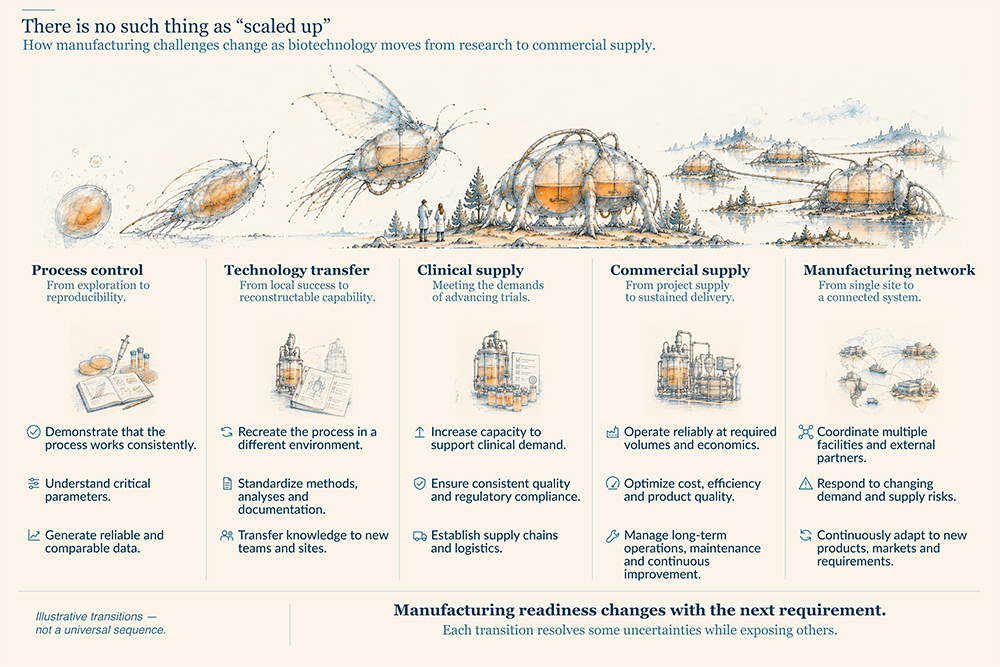
These cases span cell therapies, radiopharmaceuticals, gene therapy, and vaccines. They do not form a universal development ladder. But the same questions recur: Can the biology be reproduced? Can a research process become controlled GMP manufacturing? Can it be transferred? Can the next clinical stage be supplied? Can commercial demand be met economically? Can the network withstand change?
Each transition answers one question while exposing another.
Each transition answers one question while exposing another. Biotechnology processes are standardized, transferred, automated, redesigned, outsourced, and distributed as their requirements evolve.
A manufacturing system can be successful and still need to change. The useful question is not simply whether a biotechnology has been scaled up, but what its manufacturing system is ready for – and which requirement is likely to challenge it next.
about the author

Maxim Bril’kov, PhD, is a biotechnology researcher and process engineer based in Norway. His background combines industrial process development with academic research in molecular biology. He is particularly interested in the challenges of translating scientific discoveries into reliable industrial processes.
References
[1] Dendreon Corporation. “Dendreon Announces Strategic Restructuring to Accelerate Path to Profitability and Future Growth.” 30 July 2012. SEC-hosted company release. Documents COGS of 77% in Q2 2012 and planned New Jersey
plant closure.
https://www.sec.gov/Archives/edgar/data/1107332/000119312512322-
446/d379836dex991.htm
[2] Zelluna. “Zelluna Reaches Major Milestone with Manufacturing Process Established in Preparation for Clinical Entry of ZI-MA4-1.” 22 April 2025.
Company-reported scale, automation and process lock.
https://zelluna.com/investors/news/zelluna-reaches-major-milestone-with-manufacturing-process-established-in-preparation-for-clinical-entry-of-zi-ma4-1-its-novel-tcr-nk-therapy-targeting-solid-tumours-2
[3] Zelluna. “Zelluna Completes First GMP Batch of ZI-MA4-1.” 12 December 2025. Company-reported GMP batch production and QC testing.
https://zelluna.com/investors/news/zelluna-completes-first-gmp-batch-of-zi-ma4-1-a-novel-tcr-nk-cell-therapy-to-treat-patients-in-upcoming-first-in-human-trial-2
[4] Anocca. “Anocca Secures GMP Manufacturing License to Push Novel KRAS
TCR-T Cell Therapies Into Clinical Development.” 4 January 2024. Swedish regulator-issued GMP compliance certificate, reported by company.
https://www.anocca.com/company/news/anocca-secures-gmp-manufacturing-license-to-push-novel-kras-tcr-t-cell-therapies-into-clinical-development
[5] NorthX Biologics. “NorthX Biologics achieves milestone GMP certification to manufacture vididencel.” 1 December 2025. Company-reported process transfer
and GMP milestone.
https://www.nxbio.com/northx-biologics-achieves-milestone-gmp-certification-to-manufacture-vididencel/
[6] Oncoinvent. Investor presentation, July 2025, “Manufacturing and supply”
slide. Reports in-house GMP pilot capacity of approximately 200 Radspherin doses/year and need for Phase 3 outsourcing/scale-up. This is a company assessment/plan, not demonstrated future capacity.
https://www.oncoinvent.com/wp-content/uploads/250702-Oncoinvent-Presentation-for-webcast-vFINAL.pdf
[7] US Food and Drug Administration. ADSTILADRIN original approval letter, 16 December 2022. Regulatory confirmation of original approval and FinVector site.
https://www.fda.gov/media/164030/download
[8] Ferring Pharmaceuticals. “Ferring Pharmaceuticals Receives U.S. FDA
Approval of Drug Substance Manufacturing Scale-up Process for Gene Therapy ADSTILADRIN.” 12 June 2023. Company announcement of FDA-approved manufacturing supplement.
https://ferringusa.com/?press=ferring-pharmaceuticals-receives-u-s-fda-approval-of-drug-substance-manufacturing-scale-up-process-for-gene-therapy-adstiladrin-nadofaragene-firadenovec-vncg
[9] Ferring Pharmaceuticals. “U.S. FDA approves second drug product manufacturing facility for Adstiladrin.” 24 April 2025. Company announcement of FDA approval of Parsippany drug-product site.
https://www.ferring.com/u-s-fda-approves-second-drug-product-manufacturing-facility-for-adstiladrin-nadofaragene-firadenovec-vncg/
[10] Bavarian Nordic. “U.S. Government Orders Another 2.5 Million Doses of Monkeypox Vaccines from Bavarian Nordic.” 15 July 2022. Announcement of planned US fill-finish technology transfer.
https://www.bavarian-nordic.com/investor/news/news.aspx?news=
6591
[11] Bavarian Nordic. Sustainability Report 2022, p. 18. Retrospective confirmation of US contract manufacturer agreement and internal production reprioritization.
https://www.bavarian-nordic.com/media/324130/bn_sustainability_
report_2022.pdf
Published: November 1, 2026