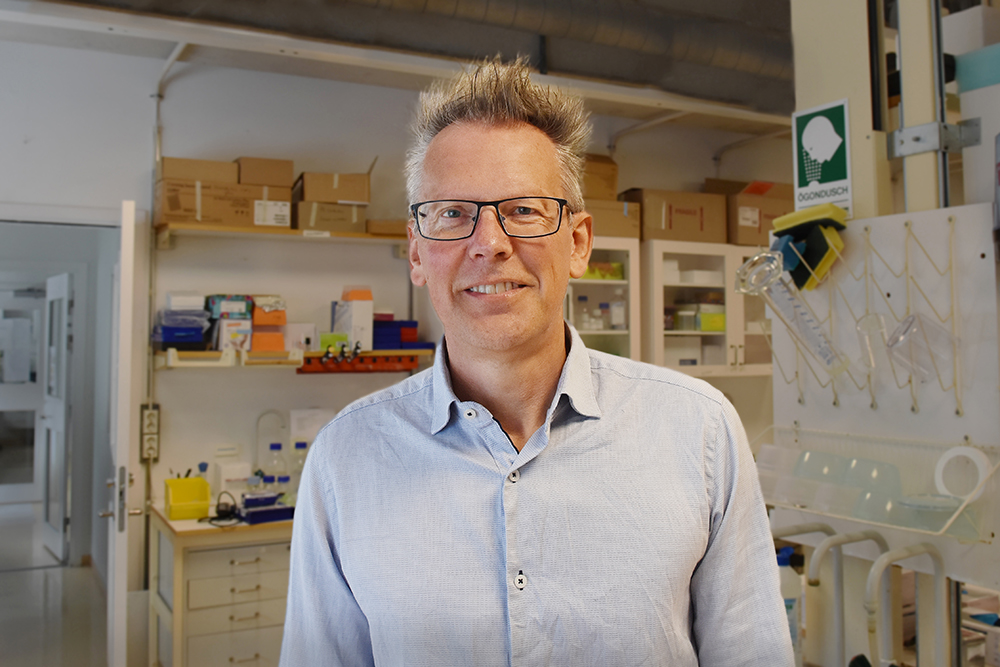
Tarek Samad on the next test for Lundbeck’s Parkinson’s drug

Lundbeck has randomized the first patient in the Phase II DARE2 trial of its oral Parkinson’s candidate Lu AF28996. In an interview with NLS, Tarek Samad, Head of R&D, explains what the trial needs to show to justify Phase III and where the drug could fit alongside existing treatments.
October 6, 2026


Lundbeck presented Phase Ib results for Lu AF28996 at the MDS 2026 congress in Seoul. In the open-label trial, 34 people with advanced Parkinson’s disease received the drug twice daily for six weeks, and 25 continued into an extension of up to 12 weeks. At week 6, daily Good ON-time (time with good symptom control and no troublesome involuntary movements) had increased by 3.6 hours from a baseline of 9.5 hours. OFF-time had fallen by 2.3 hours, and participants’ daily levodopa dose had fallen by 53.4%. Most adverse events were mild.
The trial had no placebo or comparator group, so the drug is now being tested in the randomized, placebo-controlled DARE2 trial in about 150 patients. Recruitment is underway in the US, and further sites are planned in Europe, including Sweden, and in Japan.
The bar for Phase III
Nordic Life Science asked Tarek Samad, Executive Vice President and Head of Research & Development at Lundbeck, what DARE2 would need to show to justify a move into Phase III.
“The Phase Ib data presented at MDS are very promising and give us a good rationale for moving into Phase II,” he says. “DARE2 is our proof-of-concept Phase II trial, designed to determine whether the encouraging signal seen in Phase Ib can be confirmed in a randomized, double-blind, placebo-controlled setting.”
The key measure is Good ON-time, the trial’s primary endpoint. “To support progression into Phase III, we would want to see a clinically meaningful and statistically significant improvement in Good ON-time – essentially, whether we can give patients more time during the day with good motor control without troublesome dyskinesia. Importantly, we would also look for a consistent effect on OFF-time and a clear pattern of efficacy across clinically relevant outcomes,” Samad says.
Lundbeck will also look at motor symptoms, functioning, quality of life, and the potential to reduce the overall levodopa burden, together with safety and tolerability. “Ultimately, the decision to move into Phase III will be based on the totality of the data and whether they demonstrate a robust and consistent benefit–risk profile,” he says.
DARE2 is expected to be completed in 2028, and Lundbeck will give further guidance on timing as the program progresses.
A challenging stage of the disease
Asked which patients Lu AF28996 is being developed for, Samad points to people with Parkinson’s disease who continue to experience significant motor fluctuations despite optimized non-invasive treatment.
“This is an important stage in the treatment journey. As Parkinson’s progresses, the therapeutic window of levodopa can become increasingly narrow, and patients may cycle between OFF-time, when their symptoms return, and periods of troublesome dyskinesia. For some patients, treatment may ultimately progress toward more complex, device-aided therapies,” he says.
If successful, Lu AF28996 could potentially extend effective non-invasive treatment for patients whose motor complications are no longer adequately controlled with existing non-invasive therapies.
Lu AF28996 is an oral prodrug of a dopamine receptor agonist that acts on both D1-like and D2-like receptors. It is designed to provide prolonged dopaminergic stimulation.
“The therapeutic objective is to increase Good ON-time by reducing OFF-time, while exploring the potential to reduce troublesome dyskinesia and levodopa burden,” Samad says. “If successful, Lu AF28996 could potentially extend effective non-invasive treatment for patients whose motor complications are no longer adequately controlled with existing non-invasive therapies.”
In-house research and partnerships
At MDS, Lundbeck also presented baseline data from MASCOT, its Phase III trial of amlenetug in multiple system atrophy (MSA). The trial has enrolled 401 participants and is expected to report results in Q3 2027. Amlenetug is being developed under a research and licensing agreement with Genmab.
Nordic Life Science asked how high a priority movement disorders are for Lundbeck, and whether growth will come from in-house research, partnerships, or acquisitions.
“Movement disorders are an important area for Lundbeck and one where we believe we can make a meaningful difference. There is still substantial unmet need, both in managing the complications of established disease and, ultimately, in changing the underlying course of these disorders,” Samad says.
We don’t see internal and external innovation as competing strategies. We need both.
According to Samad, the two candidates illustrate the company’s approach. Lu AF28996 originated from Lundbeck’s own research and addresses motor complications pharmacologically. Amlenetug explores a very different biology, targeting alpha-synuclein with the ambition of modifying disease progression.
“We don’t see internal and external innovation as competing strategies. We need both. Lundbeck has deep expertise in neuroscience, and we want to build on that through our own discovery while bringing in complementary science through partnerships, licensing, and, where there is a strategic fit, acquisitions,” he says. “For us, the important question is not where an innovation originates. It is whether the science is compelling, whether it addresses a significant unmet need, and whether Lundbeck has the capabilities to translate that science into a meaningful treatment for patients.”
Published: October 6, 2026