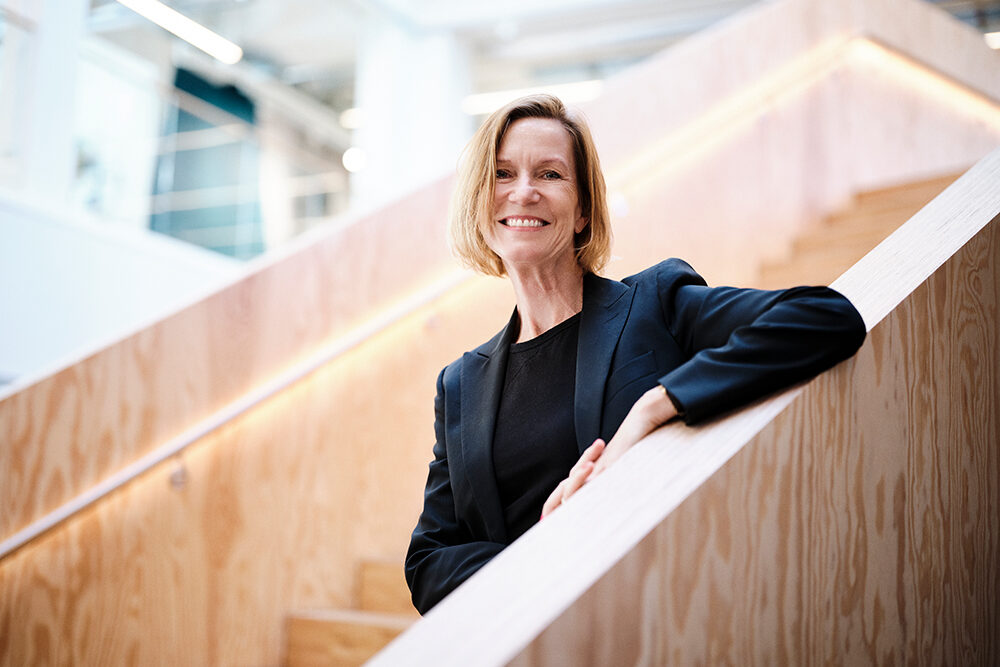
Leif Johansson: “We should double the government’s R&D funding from 1% to 2% of GDP”

Successful businessman and former chairman of AstraZeneca, Leif Johansson, has accumulated vast experience and knowledge about international competition, leadership, business development, and entrepreneurship, not least when it comes to science-driven industries like the life science industry.
December 8, 2025


Exclusively for Nordic Life Science, Leif Johansson shares his views on the current global financial and geopolitical landscape, Sweden as a brand, and how we can help the next wave of Nordic startups succeed.
What did it mean to be a global citizen in 1968, in 2000, in 2010, and now in 2025, and what has changed most?
“In 1968 we lived in a clearly divided world. West vs East and the Cold War. Europe wasn’t so accessible to Sweden. In 2000 we had joined the European Union (EU), and of course, globalization was very much the talk of the day. As companies, we were able to both visit and develop businesses in China, countries like India, and the whole of South America. Most notably perhaps, as a member of the EU, we were able to develop business in the entire greater Europe, including Russia.”
Perhaps we are returning to a more regionalized world. For most companies that doesn’t mean that they will be developing regionalized products but that they will be manufacturing them in different regions rather than being able to supply a really global supply chain.
“We’re now in a unique situation where much of the forever globalization trend has stagnated, to say the least. Perhaps we are returning to a more regionalized world. For most companies that doesn’t mean that they will be developing regionalized products but that they will be manufacturing them in different regions rather than being able to supply a really global supply chain. In many ways, really global supply chains are broken, but this is hopefully not true of strategic product development.”
How would you describe Sweden as a brand today versus around the year 2000?
“In my view Sweden has always been a good brand but it has changed over the years. In the sixties and before 2000 I think we were viewed with some skepticism as a socialist country, especially in the eyes of the US. Ever since the early nineties, we have reversed that image very much into becoming an entrepreneurial and business-driven community, but most of all, a science and research-driven community. We have been able to transform many of our basic industries, like steel, shipyards, etc., and we have been able to transform them into more innovative, research-based, science-driven industries.”
“On top of that, and perhaps most encouraging, we now have a young generation of entrepreneurs who are really building companies. In Gothenburg, when I grew up here in the 1970s, we had really big companies, such as shipyards. We didn’t have the 1,600 smaller companies that we have now. That’s really the best thing that has happened in the last decade and a half.”
What cultural trait typical of Nordic companies is the key driver of performance?
“First of all we should note that the life science industry is a data and science-driven industry, and I believe that the collegiality that we often have in academic circles also spills over into life science companies. And when we are good, we are able to get what I call reasonable consensus around building companies.”
Most of all I am particularly proud of the last decade when we have opened up companies to academia and to small and medium-sized companies.
“Reasonable consensus means that you cannot allow a small minority to stop decisions but it’s also always good to have a consensus-building process. I believe we are reasonably good at that, but most of all I am particularly proud of the last decade when we have opened up companies to academia and to small and medium-sized companies. This is how we are building a complete ecosystem of science, entrepreneurship, and the ability to take products to patients.”
So we know that Sweden punches above its weight. What one change would help the next wave of startups?
“What I would argue for, since we are a data and science-driven industry, is that the government should increase their spending in R&D, which right now is about 1% of GDP. Most of the 3.6% that we spend on science and R&D is company and industry-driven so I would argue that we should double the government funding from 1% to 2% of GDP.”
Most of the 3.6% that we spend on science and R&D is company and industry-driven so I would argue that we should double the government funding from 1% to 2% of GDP.
“That would have an enormous impact on basic science and academic science. In turn, this is going to translate into companies developing real science. I think that would be the most effective thing that we could do in Sweden right now.”
You are a member of the board at the Knut and Alice Wallenberg Foundation (KAW), what has KAW meant for Sweden’s innovation capacity?
“The Foundation has some brilliant people and I think the impact has been tremendous. It has been relatively free money in a system that otherwise is very structured on the university side. KAW provides researchers at Swedish universities with funds, often greater funds and with longer duration than what most public systems do. We are now heading towards SEK 3 billion per year. We’ve been able to help in providing really good, basic science opportunities for the best researchers both from Sweden and from abroad. On top of that the Foundation has been able to, for example, contribute to SciLifeLab, a successful intellectual and actual physical infrastructure.”
facts: leif Johansson
- Born: 1951
- Education: M.Sc. in Engineering, Chalmers University of Technology
- Career highlights: President and CEO of Electrolux (1994-1997), President and CEO of Volvo (1997-2011), Chairman of Ericsson (2011-2018), Chairman of the Royal Swedish Academy of Engineering Sciences (2012-2017), Chairman of AstraZeneca (2012-2023)
- Current roles: Founder and Chairman of AB Aphrae (2006), and Board member at Autoliv, Knut and Alice Wallenberg’s Foundation and a number of small deep tech companies
One of the projects at KAW is the Proof of Concepts Grant in Life Science, which bridges the gap between academic research and innovation. In addition to this initiative, are there any other types of support that would help increase innovation?
“We have been punching above our weight in academic science, and I think we could actually double that. But I also believe that we don’t have as good of a track record when it comes to transferring that basic science into companies. The Proof of Concept Grant is one initiative that addresses that, but we also need to help young entrepreneurs build companies, by promoting for example entrepreneurship and entrepreneurial schools, and building a culture of entrepreneurship. I’m seeing this at many universities and also at many companies.”
What’s your advice to academics who dream of taking a molecule or idea to clinical impact?
“Perhaps the best advice I can give is to actually take the step and go through a proof of concept, become an entrepreneur if you want to, or seek out entrepreneurs. There are lots of young people who have good entrepreneurial skills and, given the right setup, are able to run and develop companies.”
In Sweden we have a problem of getting (past) the first round of financing and then we have even more trouble to get the second round of financing. It takes a couple of rounds.
“Gothenburg University, Uppsala University, KTH Royal Institute of Technology, Chalmers University of Technology, and many more, all have venture houses today, which I believe are very useful to get over that first barrier. In Sweden we have a problem of getting (past) the first round of financing and then we have even more trouble to get the second round of financing. It takes a couple of rounds.”
Why is that? What is Sweden lacking compared to the US, for example?
“We are not so bad. We are not as good as the US, but the US is the best. That said, you should always compare yourself to the best, so if you look at what’s available in the US for research-based companies, there are a number of incubators, a number of funds, and free and intelligent capital. Intelligent in the sense that they know what they are investing in, they’re not only a source of capital. The more we can emulate that availability of intelligent capital, or attract intelligent capital from the US or the UK, the more we can use that as a way to replicate things in Sweden.”
The more we can emulate that availability of intelligent capital, or attract intelligent capital from the US or the UK, the more we can use that as a way to replicate things in Sweden.
“Being able to make good pitches, packaging financing rounds, and developing milestones that an investor can look at and say, “we have an opportunity in this”, are also important success factors. All of those are entrepreneurial skills, that is, understanding how investments work rather than science and data.”
Sweden has had a lot of success in tech and AI recently. The pharma and life science industry has not seen comparable success, why is that?
“Pharma companies are high risk-high reward. That means that you need to attract certain types of investors who know the industry and know it well enough. If they don’t know the industry well enough, they usually underestimate the risk. You might have someone making a brilliant pitch that can sell almost anything but then it ends up a disappointment because the risk reward is not well understood.”
“But I think we are improving, we have a number of Swedish scientists and entrepreneurs that have been able to attract capital in the US. I would have liked to see that capital being provided in Sweden but I’m not against the US doing it. It is more important that the medicine gets to the patients than who actually funds it.”
6 x quick questions to leif johansson
- Who would you bring to a desert island?
The only person that I would like to be alone with on a desert island is my wife. - If you could live your life again, is there anything you would have done differently?
In business life there are many things that do not go as you intended them to. But one of the things that you need to learn is to cut your losses and move on, and I’m fairly good at that. I have what I call a professional bad memory. - If you could see the world through someone else’s eyes for one day, whose eyes would you choose?
I would be interested to look at the world from a pair of Chinese eyes, and see how today’s global developments are perceived through those eyes rather than our western eyes. - What’s the finest compliment that you have ever received and why did it matter to you?
I was fired once by a very charismatic leader. Then I was re-hired the morning after when we both had calmed down a little. And then he said, “we really want you to stay here at the company”, so that was good. - When were you last really sad and why?
At funerals. At my age you lose friends. Not only through accidents but through normal life. You cannot say that the funerals are pleasant, but they are rituals of how to best to deal with that sadness. - What does a really good weekend look like for you?
A really good weekend is at Marstrand. Sail out across the harbor in my small boat “a snipa” and then having lunch outdoors. There’s nothing as good as eating in the forest or at sea.
About the interview and the author
The interview was conducted during NLSDays 2025, October 14, 2025 by Gustav Ceder, Communications Officer at SciLifeLab and Human Protein Atlas, and writer and communications consultant at Cedera AB.
Published: December 8, 2025