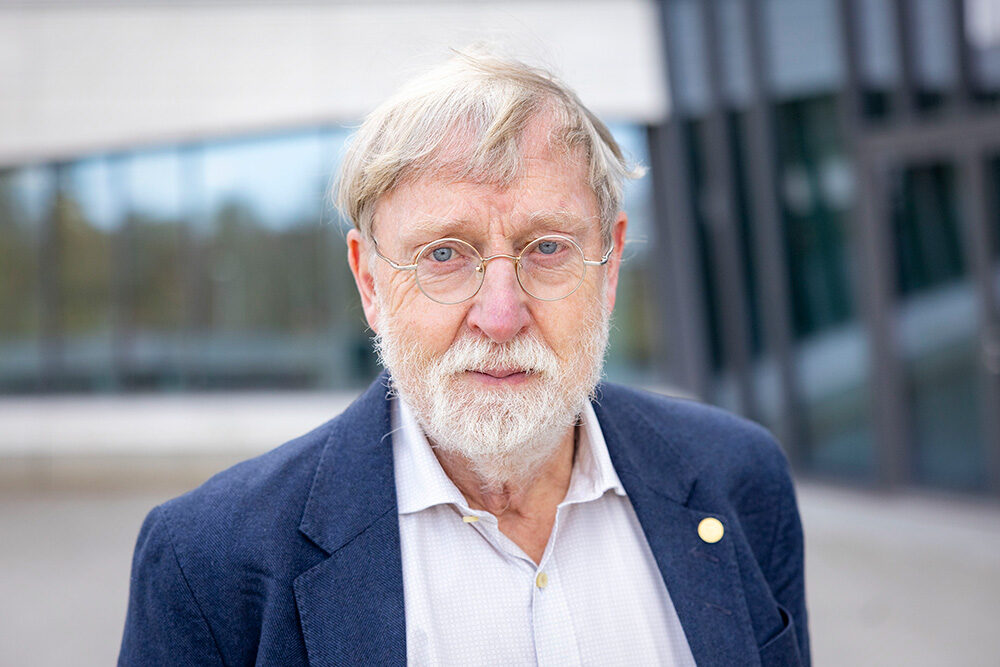
Arthur Ashkin: The power of light

Dr. Arthur Ashkin, PhD, knew 40 years ago he had developed something special.
December 20, 2018


Ashkin, an American, received the 2018 Nobel Prize for physics for his work developing optical tweezers, or an optical trap – a way to capture small particles with beams of light. He shared the prize with physicists Gérard Mourou of France and Donna Strickland of Canada, for their work with lasers, involving creating strong, short optical bursts. The combined research of the three scientists led to the development of laser eye surgery, among other breakthroughs.
A reporter in the yard
At the age of 96 [at the time of this interview, 2018], Ashkin was the oldest Nobel Prize winner in history.
“That gives me all kinds of bragging rights,” he joked to NLS.
Since he made his discoveries while working at Bell Laboratories – now Nokia Bell Labs – in New Jersey in the 1970s, he was not sitting by his phone October 2nd, 2018, expecting the Nobel committee to call. When the phone did ring at 5 a.m., his wife answered and was about to hang up, thinking it was a joke. But then Ashkin took the phone and after a few minutes, the caller convinced him that he was indeed a Nobel Prize winner.
Right after Ashkin hung up, the phone rang again and it was a reporter from the Reuters news service, telling him he had won and asking for an interview. “I told him I was in my pajamas,” Ashkin said. “He said, ‘I’m in your yard.’ My wife let him in while I got dressed.”
A wave on camera
Sadly, Ashkin was unable to attend the festivities in Stockholm in December because he had been recently diagnosed with lymphoma and was undergoing treatment. His son Michael accepted the award for him; watching the ceremonies on TV, Ashkin was delighted when his son and Sweden’s King Carl XVI Gustaf waved at him on camera.
Ashkin’s Nobel lecture was delivered by René-Jean Essiambre, a friend and colleague from Nokia Bell Labs, where Ashkin spent his entire career. He did, however, deliver his address at a ceremony at Nokia Bell Labs in New Jersey.
The inventor of levitation
What Ashkin discovered and perfected was a way to use focused beams of light to pick up tiny particles, even living ones such as bacterium, cells and algae. “You can pick up all different things and they stay alive; the light doesn’t burn them,” explained Ashkin. He also trapped sodium particles.
Ashkin used laser beams in 1970 to trap and relocate tiny transparent beads. He shone a laser beam on beads while they were in water, and the beam propelled the beads and moved them toward its center. Ashkin trapped a bead by directing two light beams of equal intensity at each other.
During his research Ashkin also discovered that by pushing on a particle with light beams, it would rise. When the particle was pushed upward, the light beams grabbed it, but the particle did not tip to one side, outside of the beam.
“I am the inventor of levitation,” Ashkin joked in discussing his discoveries.
Military by day – School at night
As a young boy in Brooklyn, New York, Ashkin became fascinated with the power of light when he used a Crookes radiometer, also called a light mill. The device has four paddles on a spindle inside a glass bulb with a near vacuum. When the paddles are exposed to light, they rotate, increasing speed as the intensity of the light increases.
In high school, Ashkin did well in science and after graduation enrolled at Columbia University to study physics. While he was in college, World War II began, but instead of being drafted, he was recruited to work at the college’s radiation lab, building magnetrons for the U.S. military’s radar systems. The military later assigned him to the reserves, and after the war ended, Ashkin worked for the military during the day and attended school at night. After receiving his bachelor degree, Ashkin attended Cornell University, where he earned a Ph.D in physics in 1952.
He also met his wife, Aline, who was studying chemistry at Cornell. She later became a high school chemistry teacher. Ashkin added that he never took a chemistry course in college, which some find surprising. When he signed up for chemistry at Columbia, the professor kept teasing him about being a physics major. “So I dropped the course.”
47 registered patents
After graduation, Ashkin was recruited by Bell Labs in New Jersey, where he was involved with optical fibers and continued his work with magnetrons.
“Then the laser was invented, and after that, I worked with lasers,” he said. During his career he registered 47 patents and earned the ranking of fellow in the Optical Society of America, the American Physical Society and the Institute of Electrical and Electronics Engineers.
Experiments in the basement
Ashkin remained at Nokia Bell Labs for 40 years, from 1952 to 1992. Since retiring from Bell, he has not been idle; Ashkin took home most of the equipment from his lab at Bell, set it up in his basement and begin experimenting.
“I am working on other things, like trying to make solar energy more cost-effective,” Ashkin explained. It could be time for another discovery.
Editor’s note: Arthur Ashkin passed away in September 2020
Arthur Ashkin
- Award: Nobel Prize in physics for developing optical tweezers
- Current Position: Retired
- Born: September 2, 1922
- Nationality: American
- Born: Brooklyn, NY, USA
- Education: Ph.D., Cornell University, B.A. Columbia University
- Personal: Married, three children, five grand-children, two great-grandchildren
Updated: August 6, 2025, 03:09 pm
Published: December 20, 2018