Five things that will decide the next decade

The Life Science Cluster turns ten. But instead of looking in the rearview mirror, let’s look at why life science will matter more over the next decade.
September 21, 2026


The Life Science Cluster was founded in Oslo in the spring of 2016 to accelerate industrial development in life science and biotechnology. The premise was that Norway had strong research and technology environments and a credible starting point for building a sustainable industry. Within a short time, the cluster counted more than 60 startups, large companies, academic and research institutions, universities, and service providers, working to strengthen collaboration and knowledge-sharing between academia, industry, technology transfer offices, investors, and public authorities.
Ten years on, the cluster has more than doubled. We have members of all sizes across aquaculture, agriculture, and human health, and we have built network arenas with real impact. Our annual Investor Partnering Day reached a new high this year, bringing together more than 160 investors and companies from across the Nordics and Europe.
Ten years is also long enough for the technological foundations to shift. When we started, predicting the structure of a protein was a research project in itself. Today it is a routine step. Last year, a child in the United States received a gene-editing therapy built for a single mutation, treated around six months after diagnosis. The cycle from biological insight to product is getting shorter, and the tools are spreading faster than institutions are able to adapt to them.
With 28 million people, the Nordic region sustains a life science research community that larger economies struggle to match. Population registries and biobanks hold decades of linked records, and their value increases as AI models improve at turning data into insight.
There is momentum in life science right now, but it cannot be taken for granted. Political priorities shift constantly. Here are five things we need to do to stay relevant.
1. We need to invest in our strengths: With 28 million people, the Nordic region sustains a life science research community that larger economies struggle to match. Population registries and biobanks hold decades of linked records, and their value increases as AI models improve at turning data into insight. But data is only an asset if it can be accessed, and only for as long as people are willing to let us use it.
Norway’s own positions are specific. We hold time series on fish health and farming that exist nowhere else. We have had a strong radiopharmaceutical environment since the 1980s, and radioligands now constitute a new drug class built on it. We are a global leader in fish health, where vaccines have reduced antibiotic use in salmon farming by more than 99 percent even as production grew. We produce contrast media that hospitals in more than 100 countries depend on, and cell therapy technology used in cancer treatments worldwide. These positions took decades to build. Without investment and the right framework conditions, they can be lost in a fraction of that time.
2. We need to build production capacity: We are living through a time of geoeconomics, where economics and politics are entangled, and states use trade, finance, and technology to pursue foreign policy and security objectives. A pandemic and a war on European soil have made supply dependency a real issue. Commercial production capacity has become national preparedness.
3. We need to see the Nordics as a single entity: Different countries have different strengths. Denmark has scale in pharmaceuticals, Sweden in research infrastructure and venture capital, Finland in diagnostics and data infrastructure, and Norway in ocean-based biology and radiopharmaceuticals. Together, the Nordics can build a strong offering to the world, but only if we collaborate far more across Nordic borders than we do today.
4. We need to build a bigger tent: Networks on the European scene matter more than they used to. Norway and the Nordics are too small to compete alone, and the rules that will shape this industry are increasingly written in Brussels and beyond. We need stronger relationships with Europe, closer to where frameworks and regulations are made.
5. We must build security by design and be more resilient: What we develop can do enormous good, but the same capabilities can cause harm if they are misused or handled carelessly. Biology is one of the few fields where a single case of misuse can undo a decade of public goodwill. It is therefore in the industry’s own interest to put security at the heart of how we build the next generation of biotechnology. The same logic applies to change itself. Much of what will matter most in ten years is not visible today. What protects us is not predicting correctly, but being ready to adjust: a broad competence base, people who can work across sectors, and companies that are able to change direction when it’s needed.
Every one of these five things is a collective problem. No company solves them alone, and no government solves them without industry. That is what a cluster is for: a place where companies across sectors discover they have the same regulatory problem, where academia meets industry before the research is finished, and where 130 members can speak with one voice to those who set the terms. This is the work for The Life Science Cluster in the coming years, and we look forward to doing it with our members.
About the authors
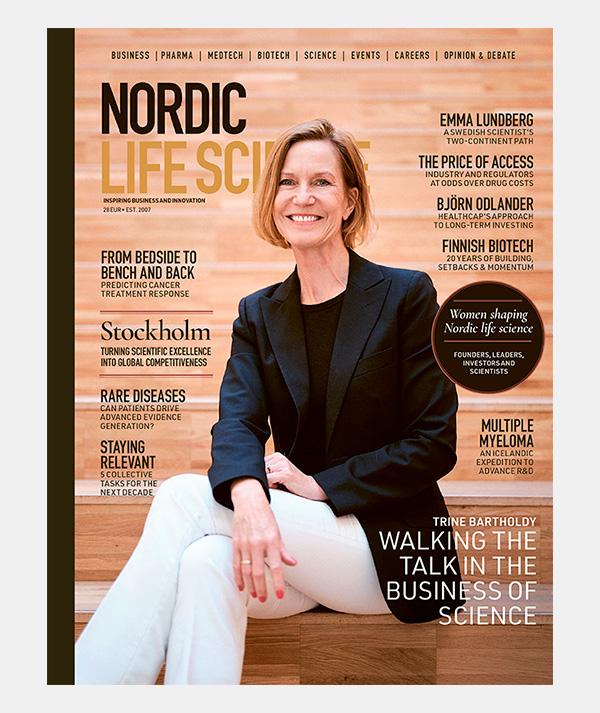
This column was written by Lotte Skolem, Chair of the Board, and Delphine Costa, CEO, The Life Science Cluster, for NLS magazine No 03 2026, out September 2026. The Life Science Cluster is a recurring columnist in NLS magazine.
Published: September 21, 2026