Julia Ravanis: Shining a light on knowledge

It’s one thing to “do” physics – but it’s another to explain its fundamentals to others, and the role that physics and other sciences play in their lives.
April 22, 2026


Sweden’s Dr. Julia Ravanis, PhD, has that skill and is building a network of people to join her on that mission. After earning her History of Technology doctorate at Chalmers University of Technology, Gothenburg in 2025, she was appointed as project manager of an initiative to design a popular science platform in the Division of Nano and Biophysics at Chalmers and the COMMONS Research Center at Lund University.
The goal of the platform is to establish ways for researchers to engage in the “third task” of science, which is communicating their findings to the public and fostering conversations about contemporary issues.
Julia Ravanis has already received recognition for her efforts, which include writing essays and books, speaking engagements, and using poetry, art and theater to make science more accessible and show people its role in their lives.
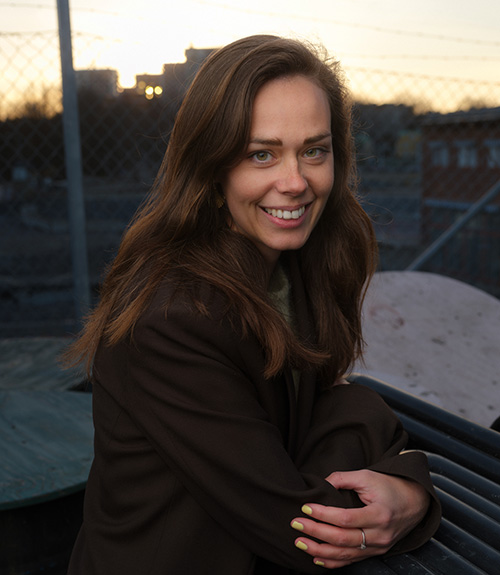
She earned the first Swedish Young Academy’s Research Lighthouse Prize last year, which recognizes people who shine a light on knowledge. Ravanis was honored “for her innovative way of spreading knowledge across generational boundaries through a unique combination of poetry, humanities and natural sciences.” The award was a surprise, according to Ravanis. She was encouraged and felt it proved that what she and others are doing to spread the word about science is important and appreciated.
A popular science writer
Ravanis, who also has master degrees in the History of Science and Ideas and Engineering Physics, began reflecting on how different disciplines, such as the sciences and humanities, connected before she began her doctorate at Chalmers.
“I started thinking about learning in a different way,” Ravanis says. “As a student, I started writing a book to satisfy my own curiosity. I wanted to explain physics, make it more accessible, and also explore what it means for our views of ourselves and the world. I’ve always been interested in the connection between philosophy and physics and the parallels between physics, existential questions, and emotions.”
This led to her first book, The Beauty in Chaos, a collection of essays mixing philosophy and physics.
“One thing led to another after the book was published. I got involved with a cultural journal in Sweden called Glänta and decided to write another book,” Ravanis says. “I realized it might just be possible to make a living as a popular science writer and talk about science to a broader audience.”
When you are writing for academia there are lots of restrictions; in essayistic writing it’s much easier to combine perspectives and theories from different fields, and you don’t have to fit into a mold.
After all her academic writing, Ravanis finds that crafting essays for the public is a chance to be more expressive.
“I love to write, and writing essays really suits me,” she says. “It’s liberating to write for a broader audience. When you are writing for academia there are lots of restrictions; in essayistic writing it’s much easier to combine perspectives and theories from different fields, and you don’t have to fit into a mold.”
Growing up in Höganäs, Sweden, Ravanis did not have to look far for writing inspiration. Both her parents were journalists. “Both reading and writing was a natural part of my childhood,” she says.
While neither of her parents were interested in math and natural sciences (they favored literature and philosophy) Ravanis says she had been curious about physics since she was young. Their house was filled with books, and she devoured novels and books about science. Family discussions were also commonplace. “I come from a very loud family,” Ravanis jokes.
“We’ve never been afraid of conflicts; my siblings and I were encouraged to make our own paths and had a lot of freedom to choose unique routes.”
When she is not working, she enjoys traveling, seeing new things, exploring new places and reading novels. “I really appreciate all that and listening to music, experiencing art, and spending time with friends,” she says.
As for long-term goals, Ravanis is eager to continue to make her way as a writer. “In times of audio books, podcasts, and generative AI, making money out of writing nonfiction books cannot be taken for granted,” she says.
It’s hard for researchers to prioritize popular science engagements today, because it does them little credit. And cultural journals that do a lot of work to spread knowledge have dire economic circumstances nowadays.
“I love writing and want to be able to continue doing it. If I think bigger, I want academia – and society – to have a better structure for communicating science. It’s hard for researchers to prioritize popular science engagements today, because it does them little credit. And cultural journals that do a lot of work to spread knowledge have dire economic circumstances nowadays.”

Connect research to issues that are relevant to people
Like much of the world, scientists in the Nordic countries are monitoring the attacks on science in the US, and hoping the situation will stabilize, Ravanis says. “It’s very unpredictable, it’s scary to witness this from a distance,” she says.
“I don’t think that science can do much to change the situation – it requires political action, both at the highest and the lowest political levels, through people acting on the ground. Scientists can and should participate in such movements.”
And the need for scientific understanding is greater now than ever, notes Ravanis. With everyday life so technology-dependent and artificial intelligence (AI) pushing into the mainstream, knowing about different aspects of science and their involvement in society has become critical.
Popular science to me is not just about communicating what’s happening, researchers must connect their research to issues that are relevant to people. Who are we as humans, what is our place in the world, in the universe?
“We have to understand technological advancements and climate change, they are both societal and scientific issues, and we need the humanities and history to understand why the world is the way it is,” she continues. “In order to live in a world or society working for democracy, we need to be knowledgeable in a lot of different fields. Popular science to me is not just about communicating what’s happening, researchers must connect their research to issues that are relevant to people. Who are we as humans, what is our place in the world, in the universe? Religion answers a lot of those questions, but when the role of religion in society diminishes, as it has in Sweden, you need something to fill the void.”
For scientists to get their message across, the key is for them to frame their research in a way that makes it relevant to people.
“That often means stepping outside your own comfort zone and talking about the bigger context that your research takes place in. Some researchers are quite afraid of talking about existential matters, for example. But if these existential questions are related to their research, they are well equipped to do that,” concludes Ravanis.
Updated: April 24, 2026, 06:38 am
Published: April 22, 2026