MOFs that puncture and kill bacteria

Researchers at Chalmers University of Technology have found a new weapon to fight bacterial growth on surfaces like implants or in catheters.
December 1, 2025


This is a completely new application of this year’s Nobel Prize-winning material: metal-organic frameworks (MOFs), according to the researchers.

Spaces with infinite opportunities
Metal-organic frameworks are opening up exciting and previously unknown doors in many different fields, including the life science industry.
The researchers are coating surfaces with nanostructures – metal-organic frameworks – that kill bacteria mechanically. Their recently published study was carried out in a collaboration between two teams of researchers at the University: Professor Ivan Mijakovic’s and Professor Lars Öhrström’s.

“Our study shows that these nanostructures can act like tiny spikes that physically injure the bacteria, quite simply puncturing them so that they die. It’s a completely new way of using such metal-organic frameworks,” says the study’s lead author Zhejian Cao, PhD in Materials Engineering and researcher at Chalmers.
Without the need to use antibiotics or toxic metals
The coating is constructed in a way that allows it to be applied to a variety of surfaces and integrated into other materials, the scientists describe further. A major advantage of the method is that it prevents or reduces biofilm formation without the need to use antibiotics or toxic metals.
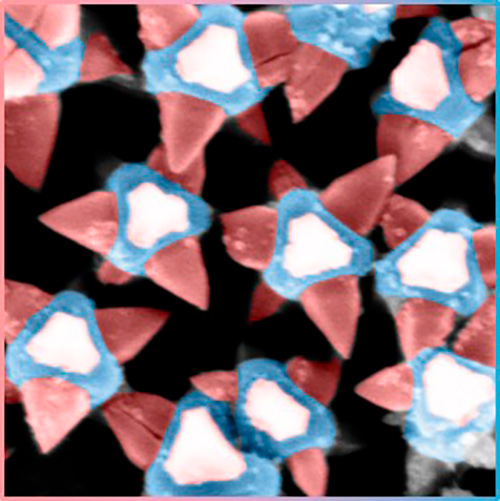
“There have been previous attempts to use MOFs for antibacterial purposes, but in those cases the bacteria were killed by toxic metal ions or antimicrobial agents released by the MOFs. Instead, we have grown one MOF on top of another, which results in the formation of sharp nanotips that can puncture and kill the bacteria when they approach,” says Cao.
Finding the right distance between the nanotips
The nanotips were created by controlling the crystalline growth in the material, and a major challenge was finding the right distance between the nanotips to maximize their effect.
“If the distance between the nanotips is too large, bacteria can slip through and attach to the surface. If the distance is too small, however, the mechanical stress exerted by the nanotips on the bacterial cell capsule may be reduced so that the bacteria survive – the same principle that allows you to lie on a bed of nails without getting hurt,” says Cao.
Facilitates large-scale production
Lars Öhrström is a co-author of the study and has worked with MOFs for 30 years. He emphasizes that there are numerous practical advantages to using MOF coatings for controlling bacteria on surfaces compared to other solutions.

“These coatings can be produced at much lower temperatures than, for example, the graphene arrays previously developed at Chalmers. This facilitates large-scale production and makes it possible to apply the coatings to temperature-sensitive materials such as the plastics used in medical implants. In addition, the organic polymers in metal-organic frameworks can be created from recycled plastics, having the potential to contribute to a circular economy,” says Öhrström.
Published: December 1, 2025