To the bones of the matter: Nordics at the frontier of organ and tissue repair

Through bioprinting pioneers and stem cell innovators, Nordic researchers are redefining how organs and tissues can be repaired and regenerated.
January 7, 2026


The promise of regenerative medicine is reshaping the future of tissue and organ regeneration and transplantation. Instead of relying solely on donor organs, scientists are developing ways to repair, replace, or even grow tissues and organs in the lab. Across the Nordics, this vision is supported by an ecosystem of public–private partnerships, academic excellence, and biotech innovation.
Prominent actors include Cellink, the Gothenburg-based bioprinting pioneer whose bioinks and printers are used globally to fabricate vascularized tissues; and the Novo Nordisk Foundation, which funds large-scale initiatives to translate stem cell biology into therapies for diabetes, neurodegeneration, and organ repair, to mention a few.
Academic institutions are equally essential. At Karolinska Institutet, the StratRegen program unites research in stem cell biology, immunology, and cardiovascular repair. This specialized initiative is supported by the Swedish government through a program for strategic research areas. At the University of Copenhagen, stem cell programs focus on translating basic biology into clinical therapies – among other things, they collaborate with Novo Nordisk on reNEW Copenhagen, a center for stem cell medicine.
Bone organ modeling and regeneration
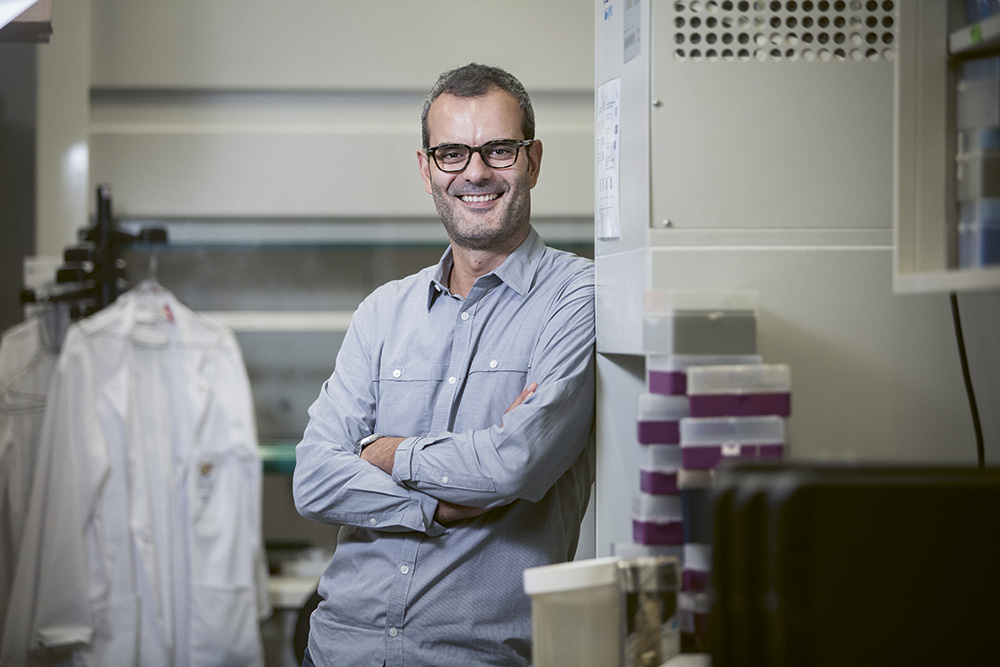
At Lund University’s Stem Cell Center, Associate Professor Dr. Paul Bourgine leads a group conducting research into bone organ modeling and regeneration, using bone as a paradigm to understand how organs form and regenerate.
Basically, our bones are built from cartilage. Stem cells first form the cartilage, and then this cartilage is calcified and transformed into bone and bone marrow tissue. Now we are capable of reproducing this process in the lab.

“The science is a combination of tissue engineering and stem cell biology. Our model organ is bone, and we are studying human bone in order to help its regeneration. At the same time, we are very interested in the bone marrow, which is responsible for blood production. So we have those two angles: finding solutions to rebuild bone, and developing models that help us understand hematopoiesis,” he explains.
Bourgine’s group takes inspiration from endochondral ossification, the natural process by which most bones form during the embryonic stage.
“Basically, our bones are built from cartilage. Stem cells first form the cartilage, and then this cartilage is calcified and transformed into bone and bone marrow tissue. Now we are capable of reproducing this process in the lab,” Bourgine says.
His lab seeds bone marrow mesenchymal stem cells (MSCs) onto scaffolds, differentiating them into cartilage. Once implanted into animal models, these engineered tissues transform into living bone. The approach has been validated in animal models and is set to be tested in one more large-animal model. Discussions with regulatory entities suggests that once the last data is collected, the research from Bourgine’s group is close to its first clinical application in humans.
Currently, the gold standard for treating damaged bone is synthetic implants, such as titanium plates, or bone autografts, whereby a piece of bone is taken from another part of the patient’s body and put into the damaged area. The latter option has obvious restraints in terms of quantity, as Bourgine points out: “You cannot take as much as you want, otherwise you have two problems instead of one.”
Unlike these current methods, Bourgine’s engineered tissue is standardized and can be applied to many different patients. Because they are produced from immortalized stem cell lines, the material can be generated in unlimited quantities. Most importantly, the cells are removed from the final product by a step defined as decellularization. That means, once they have generated cartilage in vitro, cells are removed: without cells, there is no immuno-rejection and thus the possibility to implant to any patients. Once implanted, the graft is remodeled into living bone tissue with marrow, replicating the properties of natural bone rather than synthetic substitutes.
The advantage is that our graft is fully engineered in the lab. We’re using stem cells that are immortalized so that they can produce unlimited amounts of this cartilage graft that we engineered, and it’s extremely potent.
“The advantage is that our graft is fully engineered in the lab. We’re using stem cells that are immortalized so that they can produce unlimited amounts of this cartilage graft that we engineered, and it’s extremely potent. Once it’s implanted into a defect site, it’s replaced by real bone tissue and not by synthetic materials that don’t carry the same properties as our own bone,” he explains.
Lack of standardization and financial hurdles
Despite its promise, the field of organ and tissue regeneration faces obstacles. Reproducing tissues with consistent, reliable performance remains a major challenge.
“Most approaches take the patient’s own cells, but patient cells will be of different quality depending on age, genetics, or how they are collected. If I treat ten patients with their own cells, I cannot predict in which patient the repair will be successful. This lack of standardization is a big problem in the field,” says Bourgine.
Financing is another hurdle. Large-animal studies are expensive, and regulations around which reagents and which models to use are very strict.
Paul Bourgine notes: “The problem for us now is financing those last studies. At the moment this is the major bottleneck.” His team is applying for major European grants to bridge the gap between laboratory success and clinical translation.
A new category of tissue-engineering product
Being at the bleeding edge of innovation comes with an additional, particular set of challenges, as Bourgine has experienced when going through the regulatory process: His solution for regenerating bone is so new it hardly fits into any existing regulatory category.
The European Medicines Agency (EMA) has categories for tissue-engineered products – which is in itself a relatively new field. But Bourgine’s tissue does not fit neatly into existing definitions. His team engineers tissues using stem cells, but removes the cells from the final product, leaving behind regenerated bone tissue.
I’m pretty sure there is nothing else that exists on the market, especially for the repair of skeletal tissue. Defining a new category of tissue-engineering product is very exciting.
“We are defining a completely new type of tissue engineering. The problem is that our product is indeed an engineered tissue, using human stem cells. But once this tissue is formed, we remove the cells from the final product by decellularization. What is left is actually a tissue that is composed of a lot of different proteins and the cells are not there anymore. So we have a graft that has been formed by cells, but then the cells are removed, and this change of paradigm makes the classification of this tissue-engineered product a bit more difficult for the EMA. It could be classified both as a combination of proteins (drug) or indeed a tissue-engineered product.”

For Paul Bourgine, however, this particular challenge is also the thrill:
“I’m pretty sure there is nothing else that exists on the market, especially for the repair of skeletal tissue. Defining a new category of tissue-engineering product is very exciting. It may delay the translational process, but I prefer to be delayed and do something innovative than just repeat what others are doing,” he says.
Published: January 7, 2026