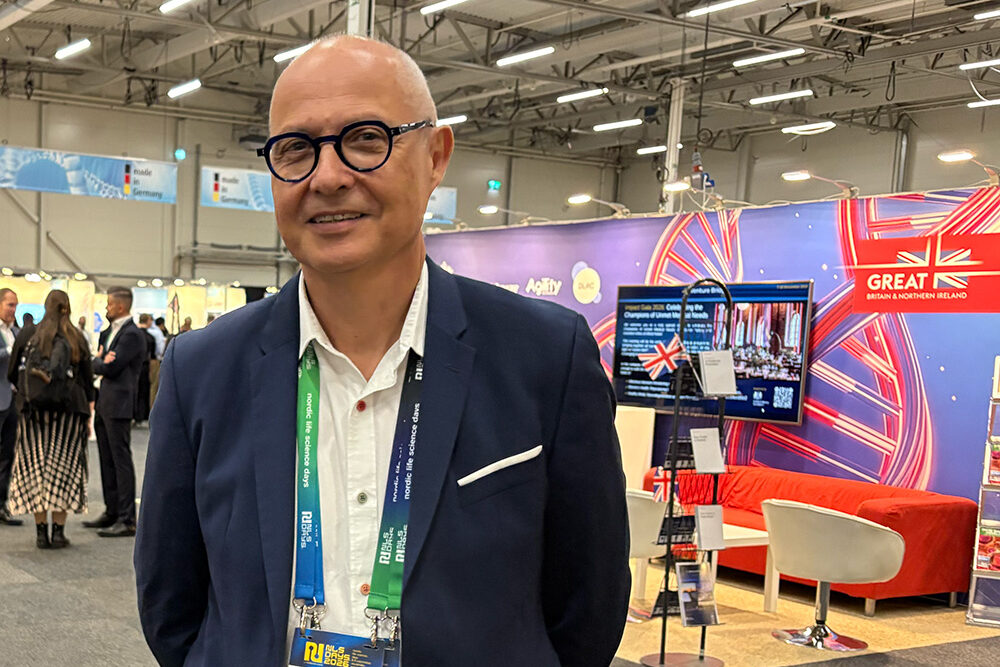
Biopharma Pioneer: Sesselja Ómarsdóttir

Sesselja Ómarsdóttir has spent her career moving between academia and industry, from lichen chemistry in an Icelandic lab to leading Genis today. She talks about mentorship, curiosity, and what it means to keep one foot in each world.
October 18, 2026


Sesselja Ómarsdóttir’s scientific career path started with a knock on a door, she recalls. After finishing her first year as a pharmacy student at the University of Iceland, she decided she wanted to work in a laboratory.
“I approached Elín S. Ólafsdóttir, then an assistant professor, and she gave me the opportunity I was looking for,” she says. “I stayed in her lab for the rest of my studies and she went on to supervise my PhD. She remains one of the most important people in my life, something close to a second mother. She shaped how I think as a scientist, and she was the first of many women who have mentored me or worked beside me since. I have been fortunate, and I do not take it for granted.”
A fundamental curiosity
Although her career path started at the University of Iceland, Ómarsdóttir’s interest in science began much earlier – in her grandmother’s kitchen. “She let me try out more or less any experiment I could think of. Later I began picking plants and making my own teas from them,” she says.
I am still driven by the same fundamental curiosity: how can that complexity be understood, controlled, and ultimately translated into something useful?
A research project on Icelandic plants during pharmacy studies changed her original plan of becoming a community pharmacist.
“What caught me was the moment when a crude extract that has shown biological activity is gradually resolved into an actual chemical structure on paper,” she says, and adds that Iceland is an unusually good place to ask these questions. Lichens, mosses, marine sponges, and bacteria living in cold water or at hydrothermal vents have adapted to extreme and often challenging environments, and those adaptations can produce fascinating chemistry.
“Much of this biodiversity has never been examined in any depth and I am still driven by the same fundamental curiosity: how can that complexity be understood, controlled, and ultimately translated into something useful? The structural complexity of these compounds fascinated me, and complex carbohydrates have stayed with me ever since,” she says.
Leading a faculty means managing budgets and hiring, having difficult conversations, and building agreement among people who are independent-minded by profession. Much of that translates directly into running a company.
Ómarsdóttir became an assistant professor in 2005 and a professor of pharmaceutical and natural products chemistry in 2014.
“Those years gave me two things in parallel. One was science. I led drug discovery programs, collaborated with researchers all over the world, and supervised a number of MSc and PhD students. The other was leadership, which I have always been drawn to. I took on committee work early, chaired teaching and program committees, and later served as vice-dean and then dean of the Faculty of Pharmaceutical Sciences. Leading a faculty means managing budgets and hiring, having difficult conversations, and building agreement among people who are independent-minded by profession. Much of that translates directly into running a company,” she says.
Part of Iceland’s biopharma industry
In 2015, Ómarsdóttir made what became one of the most transformative decisions of her career. A new biopharma industry was being built in Iceland, and the opportunity to be part of building something from the ground up was too interesting to pass up. She joined biosimilars company Alvotech and stayed for more than nine years. She rose from head of Analytical Method Development to senior vice president of Analytical R&D, and from 2021 led Pharmaceutical Sciences, with more than 200 people across Iceland, Germany, Switzerland, and India.
“I authored and defended CMC sections of global regulatory dossiers, worked directly with the FDA and EMA through regulatory review and inspections, and led a company-wide quality transformation ahead of a pivotal FDA inspection. In my final role, I served as Chief of Staff,” she says.
Iceland is small enough that a researcher, a regulator, a funder, and a company founder can be in the same room within a week. That is a genuine competitive advantage, provided we use it for speed rather than for comfortable agreement.
When it comes to Iceland’s life science industry, Ómarsdóttir highlights several areas of strength. “Genetics and population genomics are the obvious answer, but there are several others: biopharmaceutical development and manufacturing, particularly biosimilars, and marine biotechnology, one of our genuine strengths,” she says.
“Underlying all of it is scale. Iceland is small enough that a researcher, a regulator, a funder, and a company founder can be in the same room within a week. That is a genuine competitive advantage, provided we use it for speed rather than for comfortable agreement.”
Chitin derivatives
Since January 2025, Ómarsdóttir has been the CEO of biotech Genis, founded in 2005 in the Arctic town of Siglufjörður. The company focuses on the development and application of therapeutic chitin derivatives.
“Genis’ chemistry attracted me. The second thing that attracted me is that it is not a discovery-stage idea – it has done the demanding work of building process capability. The third thing is development, which is where I am most effective. The fourth thing is the potential in the technology itself. Chitin derivatives are unusually versatile, and the same underlying chemistry supports products across medical devices and nutraceuticals.”
Most of her attention is on applications in bone regeneration. “Chitin-derived materials can be produced with defined chemistry, they degrade into components the body already handles, and they are not of mammalian origin, which removes a category of viral and prion safety concerns associated with bovine and porcine grafts,” she says.
We can now dereplicate known compounds far earlier, connect chemistry to its biosynthetic origin, and spend our effort on what is actually new.
When it comes to the general opinion within the industry regarding natural products chemistry and its applications in medicine, she says that “opinion has shifted considerably over the course of my career, and I think it is now shifting back.”
“The pharma industry moved away from natural products discovery to a large extent in the 1990s and early 2000s, as combinatorial chemistry and high-throughput screening promised faster and more systematic routes to new drug candidates,” she says. “But synthetic libraries have not reproduced the structural and chemical diversity that evolution has created, and the industry has increasingly recognized that. What makes the field genuinely exciting today is that the tools have changed. We can now dereplicate known compounds far earlier, connect chemistry to its biosynthetic origin, and spend our effort on what is actually new.”
“At the same time, I feel strongly that enthusiasm for natural products must be accompanied by scientific rigor,” she emphasizes.
Combining corporate biotech leadership with an academic career
The main advantage of having one foot in the industry and one foot in academia is that you understand both environments and can build bridges between them, says Ómarsdóttir.
“The two settings are also less dissimilar than many assume. Universities tend to concentrate on basic research and industry on development, but the overlap is substantial and both conduct serious science. Academia also provides access to people, and it helps you identify talent at an early stage. Industry, in turn, imposes a discipline that academic work does not always possess: a deadline, a budget, a regulator, and the question of whether the work will ultimately be used.”
The disadvantages are equally genuine, she adds. Time is the most evident.
Both roles are full-time in their expectations, and combining them requires a degree of prioritization that not everyone finds comfortable
“A publication can be delayed by three months; a manufacturing deviation cannot. Intellectual property is a further consideration. Academic culture rewards early publication, while industrial development requires careful, sequenced disclosure. The most demanding aspect, however, is simply capacity. Both roles are full-time in their expectations, and combining them requires a degree of prioritization that not everyone finds comfortable,” she says.
Discipline and intuition
Ómarsdóttir is often asked whether her career was planned. To some extent, it was, she says. “I have always set clear goals and worked with determination toward them. But the decisions that shaped my career most were rarely made according to a plan. They came from a molecule I could not stop thinking about, an opportunity I could not resist, a person who opened a door, or a role that challenged me to step beyond what I already knew,” she says.
The decisions that shaped my career most were rarely made according to a plan. They came from a molecule I could not stop thinking about, an opportunity I could not resist, a person who opened a door, or a role that challenged me to step beyond what I already knew.
“Looking back, there has always been a balance between discipline and intuition. I believe in setting ambitious goals and working hard to achieve them, but also in being open to opportunities that were never part of the original plan. So my approach has become quite simple: set your goals with discipline but leave enough room to follow your heart and your intuition. Mine have served me well,” she concludes.
Sesselja’s Career Advice
- Learn the new technologies properly. Become genuinely fluent in these tools while building deep domain knowledge. The combination is rare, and it is where the greatest value lies.
- Go abroad, and go early. Time elsewhere changes your sense of what is possible, and the relationships you form abroad will stay with you for decades.
- Build a skill that is genuinely scarce. Analytical characterization, CMC development, regulatory science, and quality are consistently in demand and consistently underestimated by students. Comparatively few can carry a product through development, and those are the people companies compete for.
- Do not regard the move between academia and industry as a one-way door. Keep both doors open and use them.
- Learn to write and to speak clearly. The science does not speak for itself, and this is an entirely learnable skill that will repay you many times over.
- Say yes to the role you feel underqualified for. This is particularly for young women entering the field. That feeling is almost always a better signal than certainty.
Published: October 18, 2026